
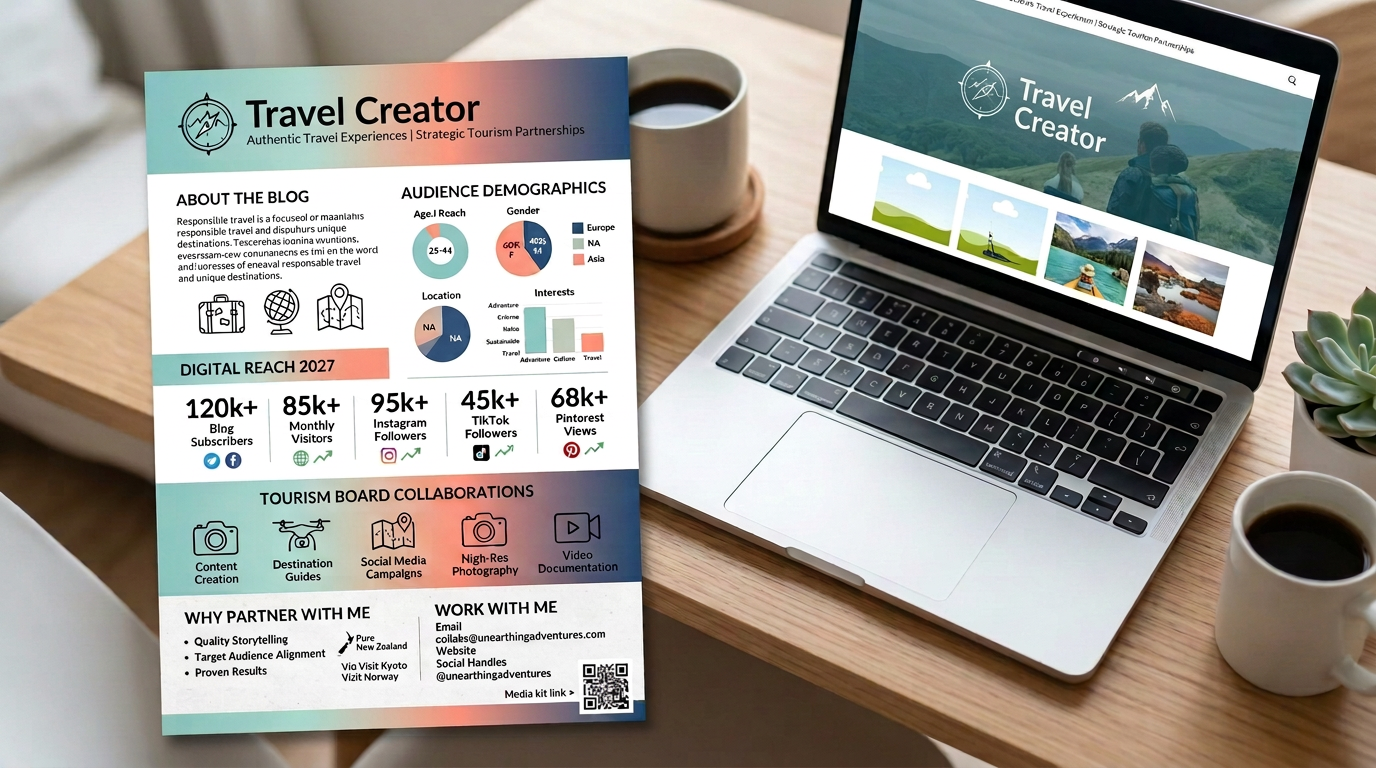
2027 is almost here. Want to travel the world, create content, and work with tourism boards? Grab a drink, a snack, and start here.
If you’ve ever looked at a travel creator’s (or ahem, maybe my) Instagram and thought:
Wait… how did they get invited to that press trip?
Or maybe you’ve seen a creator posting from a destination you’ve been dying to visit and wondered:
Did the tourism board pay for that? Did they invite them? Did they pitch first? HOW DOES THIS ACTUALLY WORK?
You’re not alone.
And I’m here to tell you something that I wish more aspiring travel creators knew:
You do not have to be a mega-influencer to start building relationships with tourism boards.
You do, however, need to understand how the tourism industry works, what you can offer, how to pitch yourself, and perhaps most importantly how to find the right person to contact.
I originally created my Tourism Board Contacts Around The World directory because I was constantly looking for this information myself. That post became one of the most popular resources on Curves and a Carry On, so for 2027, we’re taking it several steps further.
This guide is your roadmap for going from:
“I’d love to work with a tourism board someday…”
to:
“I have a pitch, a media kit, a destination strategy, and I’m actually reaching out.”
And yes, I’ve included MORE tourism board contacts to help you get started.
BTW, this is the launch post of a whole 2027 series. How to pitch hotels, vendors for activities, tracking your analytics, paid versus hosted opportunities…the works! Make sure you’re subscribed to the newsletter here on the site to find out when a new post drops, and follow me on TikTok and IG @curvesandacarryon for a short-form video overview of each lesson!
First: What Does “Working With A Tourism Board” Actually Mean?
Let’s clear up one big misconception.
Working with a tourism board doesn’t always mean:
FREE VACATION!
Tourism boards, destination marketing organizations (DMOs), convention and visitors bureaus (CVBs), and regional tourism organizations have different goals, budgets, programs, and partnership structures.
A collaboration could include:
- A hosted press trip
- A partially hosted trip
- Complimentary hotel stays
- Hosted tours or experiences
- Attraction tickets
- Restaurant experiences
- Transportation
- Destination content creation
- Social media campaigns
- Blog partnerships
- Sponsored content
- Paid creator campaigns
- Destination takeovers
- User-generated content
- Photography or video licensing
- Attendance at tourism events
- FAM trips (familiarization trips)
- Media missions
- Trade events
- Affiliate partnerships
- Inclusion in destination campaigns
Sometimes a tourism board might cover your accommodation and activities but not airfare.
Sometimes they might invite you on a group press trip.
Sometimes they might simply connect you with local businesses.
And sometimes the answer will be:
“Thanks, but we’re not currently looking for this type of partnership.”
That’s normal.
Your goal isn’t to convince every tourism board to work with you.
Your goal is to find the destinations where your audience, content style, and their tourism goals overlap.
Tourism Board, DMO, CVB… What’s The Difference?
You’ve probably seen all of these terms.
Here’s the simple version.
Tourism Board
Usually promotes tourism for a country, state, province, or region.
Examples:
- National tourism organizations
- State tourism offices
- Regional tourism boards
DMO
Destination Marketing Organization.
This is a broader industry term for organizations responsible for promoting a specific destination.
CVB
Convention and Visitors Bureau.
These organizations often promote cities or regions and may focus heavily on meetings, events, group travel, and leisure tourism.
Tourist Office
You may also encounter city or regional tourist offices that provide destination information and work with media and tourism partners.
Here’s the important part:
You don’t need to worry too much about the terminology.
What matters is finding the organization responsible for promoting the destination you want to cover.
The 2027 Creator Reality Check
Before you start emailing every tourism board you can find, let’s talk about what they actually want.
Tourism organizations are trying to attract travelers.
That means they’re interested in creators who can help them answer questions like:
Who is going to see this content?
Why will those people want to visit?
What story will this creator tell about our destination?
Can this creator reach an audience we’re trying to attract?
Will the content make people want to stay longer, explore beyond the obvious attractions, or actually book a trip?
And increasingly, tourism organizations are looking beyond traditional “beautiful destination” content.
They want stories.
They want niche audiences.
They want travelers to discover places beyond the same five Instagram locations.
They want seasonal travel.
They want diverse travelers to see themselves represented.
They want visitors to stay longer and spread tourism dollars throughout a destination.
That is GOOD NEWS for smaller creators.
You don’t necessarily need 500,000 followers.
You need to be able to explain:
Why you?
Why this destination?
Why now?
Your Creator Superpower Is Your Niche
One of the biggest mistakes aspiring travel creators make is trying to appeal to everyone.
You don’t need to be:
“A travel influencer who visits beautiful places.”
That’s incredibly difficult to differentiate.
Instead, think about what makes your perspective useful.
Maybe you’re:
- A solo female traveler
- A plus-size traveler
- A Black traveler
- An LGBTQ+ traveler
- A traveler with a disability
- A budget traveler
- A luxury traveler
- A family traveler
- A slow traveler
- A food-focused traveler
- A sustainable traveler
- A digital nomad
- An older traveler
- A first-time international traveler
- An accessible travel creator
- A traveler who focuses on train travel
- A creator specializing in Italy
- A creator specializing in hidden gems
- A creator creating travel content for Gen Z
- A creator focused on women traveling alone
Or maybe you’re several of these things.
That’s not a limitation.
That’s your pitch.
My Favorite Pitching Formula
When you’re approaching a tourism board, think:
Destination + Audience + Story + Value
For example:
I create practical travel content for solo women visiting Italy, with an emphasis on affordable experiences, local culture, and inclusive travel. I’d love to develop a series showing women how to experience [DESTINATION] independently, including transportation, food, cultural experiences, and lesser-known places.
See the difference?
You’re not saying:
“Can you send me to Italy?”
You’re presenting a content concept.
That’s what makes the second pitch much more interesting.
Before You Pitch: Do The Research
Please don’t send:
Hi! I love your destination. Can I come visit?
I promise you can do better.
Before you email, spend 20–30 minutes researching the destination.
Look at:
1. Their current campaigns
What are they promoting?
2. Their website
What stories are they publishing?
3. Their social media
What types of creators are they already working with?
4. Their target markets
Are they trying to attract American travelers?
Families?
Solo travelers?
Luxury travelers?
Off-season visitors?
5. Their current priorities
Maybe they’re trying to promote:
- Shoulder season
- Rural tourism
- Sustainable travel
- Food and wine
- Accessible travel
- LGBTQ+ travel
- Outdoor adventures
- Cultural tourism
- Smaller towns
- Longer stays
This is where your pitch gets interesting.
The “I Found Your Problem” Pitch
Here’s an advanced strategy.
Don’t just ask:
“What can I create?”
Ask:
“What is this destination trying to accomplish?”
For example:
A destination may already have plenty of content about its historic center.
But maybe very little content exists about:
“How to spend four days here without renting a car.”
Or:
“A plus-size woman’s guide to visiting this destination.”
Or:
“A solo female travel guide for first-time visitors.”
Or:
“Why you should visit in November instead of July.”
Suddenly, you’re solving a marketing problem.
And that’s much more valuable than simply offering Instagram posts.
Your Tourism Board Pitch Checklist
Before pressing SEND, can you answer YES to these?
☐ I know who I’m contacting.
☐ I’ve researched the destination.
☐ I know their current tourism priorities.
☐ I know who my audience is.
☐ I can explain why my audience would care.
☐ I have a specific story idea.
☐ I’ve included my website.
☐ I’ve included my social platforms.
☐ I’ve included relevant statistics.
☐ I’ve linked examples of previous work.
☐ I’ve explained what I can deliver.
☐ I’ve made the pitch specific to this destination.
☐ I’ve avoided writing a novel.
If you checked most of these:
SEND IT.
What Should Be In Your Media Kit?
Your media kit doesn’t need to be 25 pages.
Please.
Nobody has time for that.
For most creators, 4–8 polished pages is plenty. Email me at curvesandacarryon@gmail.com if you want to see some examples of the ones I’ve used over the years.
Include:
About Me
Who you are and what you cover.
Your Niche
Be specific.
Your Audience
Include:
- Location
- Age
- Gender
- Interests
- Relevant audience demographics
Your Platforms
Include:
- TikTok
- Blog
- YouTube
- Newsletter
Only include platforms you’re actually using.
Your Numbers
Depending on your size, include:
- Followers
- Monthly website traffic
- Monthly pageviews
- Email subscribers
- Average engagement
- Reel/video views
- Audience demographics
Previous Work
Include your strongest examples.
Especially:
Tourism-related content.
Previous Partnerships
If you’ve worked with:
- Hotels
- Tourism boards
- Tour companies
- Restaurants
- Attractions
- Airlines
- Travel brands
include them.
What You Offer
For example:
Blog
- Destination guides
- SEO articles
- Hotel reviews
- Itineraries
Social
- Reels
- TikToks
- Carousels
- Stories
- Photography
Campaigns
- Hosted trips
- Destination campaigns
- UGC
- Sponsored content
Don’t Have Huge Numbers Yet?
Pitch anyway.
But pitch differently.
If you have a smaller audience, emphasize:
Engagement
Are people commenting?
Saving?
Sharing?
Asking questions?
Search Traffic
Does Google send travelers to your website?
This can be incredibly valuable.
Niche Authority
Are you highly specialized?
What You Offer
For example:
Blog
- Destination guides
- SEO articles
- Hotel reviews
- Itineraries
- Accessible travel guides
- Plus-size travel guides
- Seasonal travel content
Social
- Reels
- TikToks
- Instagram carousels
- Stories
- Destination photography
- Short-form video
Other
- Newsletter features
- Pinterest content
- Photography
- UGC
- Video licensing
- Content for tourism-board websites
- Speaking or event coverage
Don’t promise 47 deliverables because you think it will make your pitch more impressive.
It won’t.
Offer what you can actually deliver well.
Your Numbers Don’t Tell The Whole Story
Let’s talk about follower counts.
Yes, tourism organizations care about audience size.
But audience alignment matters too.
A creator with 12,000 highly engaged followers who are specifically interested in solo travel may be more useful for a solo-travel campaign than someone with 200,000 followers whose audience doesn’t travel.
And tourism organizations themselves are demonstrating that niche audiences matter.
Visit California’s 2027 Road Trips Guide, for example, paired influencers with destinations and themes that aligned with their audiences, including culinary travel, sustainability, outdoor adventure, and more niche perspectives.
So don’t apologize for being a small creator.
Instead, know your numbers.
Be able to say:
“I have 18,000 Instagram followers, 72% of whom are women, with 38% based in the United States, and my destination articles receive approximately 25,000 monthly pageviews.”
That tells a tourism board far more than:
“I have 18K followers!”
What If Your Numbers Are Still Small?
Pitch anyway.
Seriously.
If you’re brand new, you probably aren’t going to land a five-day international press trip immediately.
That’s okay.
Start smaller.
Pitch:
- Local tourism boards
- Regional tourism organizations
- Small towns
- Attractions
- Museums
- Hotels
- Tour companies
- Restaurants
- Festivals
- Cultural organizations
- State or provincial tourism offices
- Nearby destinations
Build a portfolio.
Then use those experiences to pitch larger organizations.
Think of it as a ladder rather than a lottery.
Level 1
Local businesses and attractions
↓
Level 2
City and regional tourism organizations
↓
Level 3
State/province tourism organizations
↓
Level 4
National tourism organizations
↓
Level 5
International campaigns and major brand partnerships
You don’t have to start at the top.
How To Find The Right Tourism Board Contact
This is where my original tourism-board directory came in handy. I’m like the FBI, and sometimes I can’t find what I need, either.
But here’s something important for 2027:
Don’t assume an email address you find online three years ago still works.
People change jobs.
Departments get reorganized.
Tourism organizations rebrand.
PR agencies change.
So use contact lists as a starting point—not gospel.
Look for titles such as:
- Public Relations Manager
- PR Director
- Media Relations Manager
- International PR Manager
- Communications Manager
- Influencer Marketing Manager
- Creator Partnerships Manager
- Social Media Manager
- Content Manager
- Media Relations
- Trade & Media Relations
- Global Communications
- Digital Marketing
- Brand Partnerships
And don’t overlook the organization’s agency of record.
Some tourism boards outsource their PR and influencer relations to an outside agency.
That agency may actually be the person you need to pitch.
A Quick Tourism Board Contact-Finding Hack
Go to Google and search:
[Destination] tourism board media contact
Then try:
[Destination] tourism board PR
Then:
[Destination] tourism media relations
Then:
[Destination] influencer tourism
And finally:
site:[tourism-board-website] media
You can also search LinkedIn for:
“PR [Destination] Tourism”
or
“Media Relations [Destination] Tourism.”
You’d be amazed how often the person you need is one LinkedIn search away.
Tourism Board Contacts Around The World
This is where you can use my original resource:
See The World: Making Content? Tourism Board Contacts Around The World
That directory is still useful as a jumping-off point, but always verify the current contact information before pitching.
For 2027, I recommend bookmarking the tourism boards you actually want to work with rather than collecting 300 random email addresses.
Quality over quantity.
A Few Useful Starting Points
Here are some examples of the types of organizations you should be looking for.
United States
Start with:
- National/state tourism organizations
- State tourism offices
- City CVBs
- Regional DMOs
For example, Visit California has a dedicated industry platform with partnership opportunities, PR resources, influencer information, and media programs. Its current programs include influencer-focused opportunities and a press-trip request pathway.
Australia
Tourism Australia is particularly useful to study because it clearly explains how its media-hosting program works.
It hosts journalists, online media, broadcasters, and digital influencers, and says it is interested in hearing compelling story ideas. It also works with state and territory tourism organizations to coordinate hosted visits.
Tourism Australia’s current media guidance lists mediahosting@tourism.australia.com for national-operator media hosting inquiries.
Important: A contact email isn’t an invitation.
Read the organization’s requirements before sending your pitch.
The Difference Between A Media Pitch And A Collaboration Pitch
These are not always the same thing.
Media Pitch
You’re essentially saying:
“I have a story for my audience/publication.”
This is especially useful if you have a blog, newsletter, publication, or other editorial platform.
Collaboration Pitch
You’re saying:
“I have a content concept that I think could help promote your destination.”
This might include:
- TikTok
- Blog
- YouTube
- Photography
- UGC
- Newsletter
Paid Campaign Pitch
This is:
“Here is the campaign I can create for you, and here is my rate.”
Know which one you’re sending.
Don’t accidentally pitch a paid campaign while describing it as a “press trip.”
Press Trip vs. Paid Campaign: Know The Difference
This is one of the most important things aspiring creators need to understand.
A hosted press trip generally means the destination or partners provide some combination of travel, lodging, transportation, meals, tours, or experiences.
That does not automatically mean you receive a cash payment.
A paid creator campaign includes an agreed financial fee for your content.
A hybrid partnership may include both hosted travel and a creator fee.
There is no universal formula.
Every tourism organization has its own budget and policies.
For example, Visit California’s current Gold Pass program helps destination partners bring qualified media and influencers to California, but influencer partnership fees are the responsibility of the hosting destinations or businesses.
Always ask what is included before agreeing to a trip.
The Email Pitch
Okay.
This is the part everyone wants.
Here’s the basic structure I recommend.
Subject:
Story Idea: Solo Female Travel In [DESTINATION]
or:
2027 Content Collaboration Idea: [DESTINATION] For Plus-Size Travelers
or:
Travel Story Pitch: [SPECIFIC STORY IDEA]
Keep it specific.
Not:
“Travel Collaboration!!!”
Please.
Your Tourism Board Pitch Template
Here’s a starting point you can customize.
Hi [NAME],
My name is [NAME], and I’m a travel content creator and [blogger/journalist/photographer/etc.] focusing on [NICHE].
I create content for [AUDIENCE DESCRIPTION], with a particular focus on [SPECIFIC TOPICS].
I’m planning my 2027 travel calendar and would love to explore a potential content partnership with [DESTINATION].
I’ve been following [TOURISM BOARD/DESTINATION] and noticed [SPECIFIC CAMPAIGN/INITIATIVE/DESTINATION PRIORITY].
I’d love to propose a story/content series around:
[SPECIFIC STORY IDEA]
The goal would be to show my audience [WHAT THE CONTENT WOULD HELP THEM DO/UNDERSTAND].
Potential deliverables could include:
- [BLOG ARTICLE]
- [X INSTAGRAM REELS]
- [X INSTAGRAM STORIES]
- [PHOTOGRAPHY]
- [NEWSLETTER FEATURE]
My audience is primarily [AUDIENCE], with [RELEVANT STATISTIC].
You can see examples of my work here:
[WEBSITE]
[MEDIA KIT]
[INSTAGRAM]
If this sounds aligned with your 2027 priorities, I’d love to discuss potential dates, itinerary ideas, deliverables, and partnership opportunities.
Thank you!
[NAME]
The Secret: Make The First Paragraph About Them
This:
“I’ve always wanted to visit your beautiful destination.”
is nice.
But this:
“I noticed your 2027 campaign is focusing on shoulder-season travel, and I would love to develop a series showing solo women how to experience [destination] without renting a car.”
is much stronger.
You are demonstrating that you did your homework.
Don’t Send The Same Email To 100 Tourism Boards
This is probably my biggest piece of advice.
Please don’t write one generic email and BCC 100 tourism boards.
Instead:
Pitch fewer destinations better.
I’d rather you send five highly personalized pitches than 100 emails that sound like:
“Dear Tourism Board, I love your country and would love to collaborate.”
Your goal is to make the recipient think:
“Oh. This person actually understands what we’re trying to do.”
What Should You Ask For?
This is where newer creators sometimes get uncomfortable.
Don’t be afraid to clearly state what you’re looking for.
Depending on the project, you might ask about:
- Hosted accommodations
- Transportation
- Tours and experiences
- Attraction tickets
- Meals
- Local transportation
- Airport transfers
- Airfare
- Creator fees
- Usage rights
- Content licensing
- Photography licensing
- Itinerary support
You don’t need to demand everything.
But you do need to understand what the partnership involves.
Never Assume “Hosted” Means Everything Is Free
Before you say yes, ask:
What expenses are covered?
Specifically ask about:
- Airfare
- Hotel
- Ground transportation
- Meals
- Activities
- Travel insurance
- Airport transfers
- Wi-Fi
- Taxes
- Baggage fees
- Personal expenses
And ask:
“Are there any expected deliverables or publication requirements?”
Get everything in writing.
What About Bringing A Plus-One?
This comes up constantly.
Don’t assume you can bring someone.
Some tourism boards will host only the creator.
Others may allow a companion but require them to pay their own expenses.
Some group press trips have strict participant policies.
Tourism Australia’s media-hosting program, for example, states that its arrangements are for invited media representatives and do not extend to companions.
Ask.
Don’t show up at the airport with your boyfriend, girlfriend, spouse, best friend, mother, and emotional-support chihuahua.
Unless they specifically said yes.
What If You Have Dietary, Accessibility, Or Body-Specific Needs?
Tell them before the trip.
This is especially important for inclusive travel creators.
If you need:
- Plus-size seating
- Accessible transportation
- Mobility accommodations
- Dietary accommodations
- Medication storage
- Frequent restroom access
- Specific hotel room requirements
- Larger towels or robes
- Appropriate safety equipment
- Specialized equipment
- Other body-related accommodations
communicate those needs early.
You are not being difficult.
You’re helping the destination plan a successful trip.
Tourism Australia specifically notes that hosts should be aware of dietary requirements, cultural sensitivities, and other participant needs when planning hosted media visits.
And honestly?
The more transparent everyone is beforehand, the better the experience will be.
Inclusivity Is More Than Saying “Everyone Is Welcome”
This is an area where travel creators can provide enormous value.
A destination might say:
“We’re inclusive!”
But your audience may want to know:
- Can I actually find plus-size swimwear here?
- Are restaurants comfortable for larger bodies?
- Are trains accessible?
- Can I fit comfortably in the tour vehicle?
- Are there gender-neutral bathrooms?
- Is public transportation accessible?
- Is the destination welcoming to LGBTQ+ travelers?
- Are attractions physically accessible?
- Can solo women comfortably get around?
- Are there cultural considerations I should know about?
- Are there religious or dress expectations?
- Is the destination welcoming to travelers of color?
These are real travel questions.
Don’t be afraid to pitch them.
Your Niche Can Actually Make Your Pitch Stronger
Imagine two pitches.
Creator A
“I’d love to visit your destination and create beautiful Instagram content.”
Creator B
“I create practical travel content for plus-size women and want to show my audience how to experience your destination comfortably, including transportation, hotels, dining, shopping, and activities.”
Which one gives the tourism board a clearer idea of what they’re getting?
Exactly.
Your niche isn’t something you need to hide.
It is your competitive advantage.
The Follow-Up
You sent the email.
And…
Nothing.
Welcome to PR.
This does not necessarily mean no.
Tourism boards can receive an enormous volume of inquiries, and the person you contacted may be traveling, managing an event, working on a campaign, or simply buried under 400 emails.
Follow up.
I recommend a simple follow-up after approximately one to two weeks, unless the organization has provided a different timeline.
Tourism Australia’s own media guidance recommends following up on pitch emails if you don’t hear back within two to three days, illustrating just how different response expectations can be across organizations.
So use your judgment.
For a major destination organization, I’d usually give them a little more breathing room.
Your Follow-Up Email
Subject: Following Up — [DESTINATION] Content Idea
Hi [NAME],
I wanted to follow up on my email below regarding a potential [DESTINATION] content partnership for 2027.
I know your team is busy, so I wanted to check whether this might align with any upcoming campaigns or media opportunities.
I’m particularly interested in [SPECIFIC ANGLE], and I’d be happy to provide additional audience information, examples, or a proposed itinerary.
Thanks so much!
[NAME]
And Then… Let It Go
If you don’t hear back after your follow-up?
Move on.
Don’t send:
“Just bumping this again!!!”
“Did you see my email?”
“HELLO????”
“I really need an answer.”
No.
You are building professional relationships.
Sometimes the answer is:
Not right now.
And that can change six months later.
Build A Tourism Board CRM
This sounds fancy.
It isn’t.
You can literally use a spreadsheet.
Create columns for:
- Destination
- Organization
- Contact
- Date Pitched
- Follow Up
- Response
- Campaign
- Notes
Then add:
Status
- Researching
- Ready to pitch
- Pitched
- Follow-up needed
- Interested
- Negotiating
- Confirmed
- Completed
- Keep in touch
- No response
- No
This is one of those boring administrative things that can completely change your business.
Because six months from now you won’t remember who you emailed.
Your spreadsheet will.
My 2027 Tourism Board Pitching Challenge
Okay.
Let’s make this fun.
Instead of saying:
“Someday I’m going to work with a tourism board.”
Let’s turn it into a 30-day challenge.
Week 1: Get Your House In Order
☐ Update your website
☐ Update your About page
☐ Create/update your media kit
☐ Gather your analytics
☐ Choose your niche
☐ Choose 3–5 content categories
☐ Create a professional email address
☐ Create your tourism-board spreadsheet
Week 2: Find Your Destinations
Choose 10 destinations you’d genuinely like to cover.
Not 100.
Ten.
For each destination, find:
☐ National tourism organization
☐ Regional tourism board
☐ City tourism organization
☐ Relevant PR agency
☐ Media contact
☐ Influencer/creator contact
☐ Social media accounts
☐ Current campaigns
Week 3: Create Your Pitches
Write three different story concepts for your favorite destinations.
For example:
Destination A
“Why [Destination] Is Perfect For A Solo Female Long Weekend”
Destination B
“An Inclusive Guide To Exploring [Destination] As A Plus-Size Traveler”
Destination C
“Why You Should Visit [Destination] In The Shoulder Season”
Now choose your strongest five pitches.
Week 4: SEND THEM
Send:
One pitch.
Then another.
Then another.
Don’t wait for the first person to answer before contacting anyone else.
You’re building a pipeline.
The 5-Pitch Rule
Here’s a challenge I’d love aspiring creators to try:
Send five quality tourism-board pitches every month.
That’s it.
Five.
Over one year:
60 pitches.
Even if your response rate is modest, you’ve created 60 opportunities to build relationships.
And remember:
A “no” isn’t always a dead end.
It might mean:
“Not this year.”
Or:
“We’re not doing influencer trips right now.”
Or:
“Talk to our regional tourism partner.”
Or:
“Our budget is gone until next quarter.”
Those are not necessarily permanent rejections.
What To Do If A Tourism Board Says Yes
First:
Celebrate.
Seriously.
Then immediately become organized.
Ask for:
- Written itinerary
- Dates
- Accommodation details
- Transportation details
- Contact information
- Deliverables
- Deadlines
- Payment terms
- Usage rights
- Content licensing expectations
- Cancellation policy
- Travel insurance requirements
- Disclosure requirements
Don’t rely on:
“We’ll figure it out when you get here.”
Nope.
Get it in writing.
Ask About Content Usage
This one is HUGE.
There is a difference between:
“We’d love to repost your Instagram Reel.”
and:
“We’d like perpetual worldwide rights to use your video in paid advertising.”
Those are not remotely the same thing.
If a destination wants to use your content for:
- Paid advertising
- Billboards
- Television
- Websites
- Brochures
- Social media
- Tourism campaigns
- Partner advertising
ask what rights they are requesting.
And if you’re being paid, consider whether those usage rights should affect your fee.
Hosted Doesn’t Mean You Work For Free Forever
A hosted trip can be incredibly valuable.
You may receive:
- Travel
- Accommodation
- Experiences
- Content opportunities
- Networking
- Portfolio material
- Exposure
But if a tourism board wants substantial commercial content, extensive deliverables, advertising usage, or a large content library, it is completely reasonable to discuss a creator fee.
Know the difference between:
Editorial opportunity
and
Commercial content production.
Disclose Your Partnership
If a tourism board provides you with complimentary travel, accommodation, meals, experiences, or payment, disclose the relationship according to the rules applicable to your audience and platforms.
Don’t try to hide a hosted trip because you think disclosure will make your content less appealing.
Transparency builds trust.
Your readers deserve to know when you’ve received something of value.
Don’t Promise A Positive Review
This is another important distinction.
A tourism board may host you.
That doesn’t mean you’re obligated to pretend something was perfect.
If your content is editorial, maintain your credibility.
You can be enthusiastic while still being honest.
For example:
“I loved the destination, but I wouldn’t recommend this particular experience for travelers with mobility limitations.”
That’s useful.
And honestly, useful content is much more valuable than promotional fluff.
Be A Good Guest
If you get invited on a press trip:
Show up.
Be on time.
Be prepared.
Know the itinerary.
Don’t complain constantly.
Respect local culture.
Ask thoughtful questions.
Tag partners when appropriate.
Create the content you agreed to create.
Thank the people who hosted you.
And remember that the tourism board employee isn’t your personal vacation concierge.
They’re doing a job.
Make their job easier.
But Don’t Be Afraid To Speak Up
Being a good guest doesn’t mean accepting unsafe or inappropriate conditions.
If something isn’t working, communicate professionally.
If your room doesn’t accommodate your needs:
Say something.
If an activity isn’t physically appropriate for you:
Say something.
If the itinerary isn’t what you agreed to:
Say something.
The goal isn’t to be difficult.
The goal is to make the partnership successful.
What If You Don’t Get Invited?
Keep creating.
This is perhaps the most important part of the entire guide.
You do not need a tourism-board invitation to make destination content.
You can:
- Take your own trip
- Pitch local businesses
- Create independent destination guides
- Interview tourism professionals
- Cover events
- Visit attractions
- Build relationships with hotels
- Create seasonal guides
- Publish SEO content
- Build your newsletter
- Grow your audience
Then pitch the tourism board after you’ve already demonstrated that you can tell the destination’s story.
Sometimes your best pitch is:
“Here’s what I already created about your destination.”
The “Already Love Your Destination” Strategy
This is one of my favorite approaches.
Visit somewhere on your own.
Create excellent content.
Publish it.
Then contact the tourism organization.
Your email becomes:
“I’ve recently published a guide to [destination] for my audience of [audience]. I’m planning additional coverage for 2027 and would love to discuss whether there may be opportunities to collaborate with your team.”
That’s a completely different conversation.
You’re no longer asking:
“Will you take a chance on me?”
You’re showing them:
“Here’s what I can do.”
Don’t Forget The Small Destinations
Everyone wants:
Paris.
Rome.
London.
New York.
Barcelona.
And yes, they’re fantastic.
But they’re also incredibly competitive.
Try pitching:
- Small towns
- Rural destinations
- Regional tourism organizations
- Islands
- Emerging destinations
- Shoulder-season destinations
- Secondary cities
- Less-photographed neighborhoods
A smaller destination may be thrilled to find a creator who genuinely wants to tell its story.
And your readers may appreciate discovering somewhere they’ve never heard of.
Your Content Can Help A Destination Beyond Instagram
This is especially important if you’re a blogger.
A Reel disappears quickly.
A well-written destination guide can bring traffic for years.
Think:
Pinterest → Google → Blog → Newsletter → Booking
That’s a much more interesting value proposition.
Tourism organizations are also increasingly investing in searchable, evergreen destination storytelling. Visit California, for example, currently offers content programs designed to create discoverable stories and uses creator partnerships to extend the life of destination campaigns.
So if you’re a blogger:
Don’t undersell your website.
Your blog is not just a place to put pretty travel photos.
It can be your strongest professional asset.
SEO Is Your Secret Weapon
If you’re creating destination content, learn basic SEO.
You don’t need to become an SEO wizard.
But understand:
- Search intent
- Keywords
- Headings
- Internal links
- External links
- Meta descriptions
- Image alt text
- Helpful content
- Evergreen content
- Seasonal content
Imagine a tourism board sees that your article:
“The Ultimate Guide To Visiting Tuscany Without A Car”
ranks on Google and receives thousands of visits.
That is a very different pitch than:
“I have 8,000 Instagram followers.”
Both are useful.
But one demonstrates long-term search visibility.
The Ultimate Tourism Board Pitch Formula
If you remember nothing else, remember this:
I help [AUDIENCE] discover [DESTINATION] through [CONTENT STYLE] so they can [TRAVEL GOAL].
Then add:
Why this destination?
Show you’ve researched it.
Why this audience?
Show there’s a genuine fit.
Why now?
Tie it to a campaign, season, event, anniversary, opening, trend, or tourism priority.
What will you create?
Be specific.
What do you need?
Be professional.
What can you prove?
Show your numbers and previous work.
That’s your pitch.
Your 2027 Tourism Board Pitch Worksheet
Before you send your next inquiry, fill this out:
Destination:
Tourism Organization:
Contact:
Their current campaign/priorities:
My audience:
Why my audience would care:
Story idea:
Why this story is different:
Content I can create:
What I’m requesting:
Relevant previous work:
My strongest statistic:
My media kit:
Date I’d like to travel:
Follow-up date:
The 2027 Tourism Board Bingo Card
Because networking should be fun.
How many can you check off?
☐ Sent my first tourism-board pitch
☐ Got a response
☐ Got a “not right now”
☐ Got redirected to another contact
☐ Got invited to a tourism event
☐ Received a hosted experience
☐ Worked with a local DMO
☐ Worked with a hotel
☐ Went on a press trip
☐ Created a destination campaign
☐ Published a tourism-board partnership
☐ Got paid for destination content
☐ Had my content reposted by a tourism organization
☐ Had a tourism board link to my blog
☐ Got invited back
☐ Built a long-term destination relationship
And if you check every box?
You owe me a celebratory Aperol.
The Biggest Mistakes I See New Travel Creators Make
1. They wait until they’re “big enough.”
Stop.
Start building relationships now.
2. They focus only on followers.
Audience alignment matters.
3. They don’t have a niche.
“Travel” is a category.
Your perspective is your niche.
4. They send generic pitches.
Personalize.
5. They don’t research the destination.
Do your homework.
6. They don’t know their own analytics.
Know your numbers.
7. They say yes before understanding the deliverables.
Read the agreement.
8. They don’t discuss usage rights.
Always ask.
9. They expect every trip to be paid.
Different opportunities have different structures.
10. They don’t follow up.
A polite follow-up is professional.
11. They give up after one rejection.
Try again later with a better idea.
12. They forget the relationship after the trip.
Don’t.
The Relationship Is More Valuable Than The Trip
This is something I wish every aspiring creator understood.
The goal isn’t:
“Get a free trip.”
The goal is:
Build relationships with people who work in travel.
That tourism-board employee may move to another destination next year.
The PR agency may take on a new client.
The hotel manager may move properties.
The destination may launch a new campaign.
The person who invited you on a small regional press trip in 2027 might remember you when they’re planning a major international campaign in 2028.
Be good at your job.
Be kind.
Be reliable.
Be memorable for the right reasons.
What I Would Do If I Were Starting From Zero In 2027
Here’s my actual playbook.
January
Get the website polished.
Create the media kit.
Define the niche.
Start collecting analytics.
February
Pitch five local businesses.
Create three excellent destination articles.
March
Contact your regional tourism organization.
Attend tourism or media networking events.
April
Pitch five destinations.
Follow up with previous contacts.
May
Create a case study from your strongest partnership.
June
Pitch larger tourism organizations.
July
Refresh your media kit with your latest numbers.
August
Research fall and winter campaigns.
September
Pitch 2028 travel.
October
Start researching major tourism events and conferences.
November
Pitch holiday and winter campaigns.
December
Review:
What worked?
Who responded?
What content performed?
Which partnerships were profitable?
Which relationships should I nurture in 2028?
Then do it all again.
One Last Thing: You Don’t Have To Be An Influencer
This might be my favorite part.
You can be:
a blogger.
a journalist.
a photographer.
a newsletter creator.
a YouTuber.
a podcaster.
a TikTok creator.
a storyteller.
a travel writer.
a combination of all of the above.
Tourism organizations work with many different types of media and creators.
Tourism Australia’s current media-hosting program, for example, explicitly includes online media and digital influencers alongside traditional media.
Your job isn’t to fit into someone else’s definition of a travel creator.
Your job is to know:
What story do I tell?
Who listens to me?
Why does that matter?
And:
What can I create that makes people want to go?
Ready To Pitch?
If you’ve made it this far, don’t close this article and tell yourself:
“I’ll do this someday.”
Open a spreadsheet.
Pick five destinations.
Find the tourism organizations.
Research their current campaigns.
Find the right contact.
Write one genuinely good pitch.
And send it.
Then send another.
Because the travel industry is built on relationships.
And every creator you admire had to send a first email.
Maybe 2027 is the year you send yours.
More Travel Creator Resources From Curves And A Carry On
If you’re building a travel-content business, don’t stop here.
Start with:
See The World: Making Content? Tourism Board Contacts Around The World
Then explore the rest of my travel creator resources for building a destination-focused blog, creating useful travel content, growing an audience, and turning your travel experience into something bigger.
And if you’re specifically interested in inclusive travel, solo female travel, plus-size travel, and Italy, you’re in exactly the right place.
Because there is room for more voices in travel.
There is room for more perspectives.
And there is absolutely room for you.
Now go pitch somebody.
Rooting for you,
XO, Sondra
Leave a Reply