
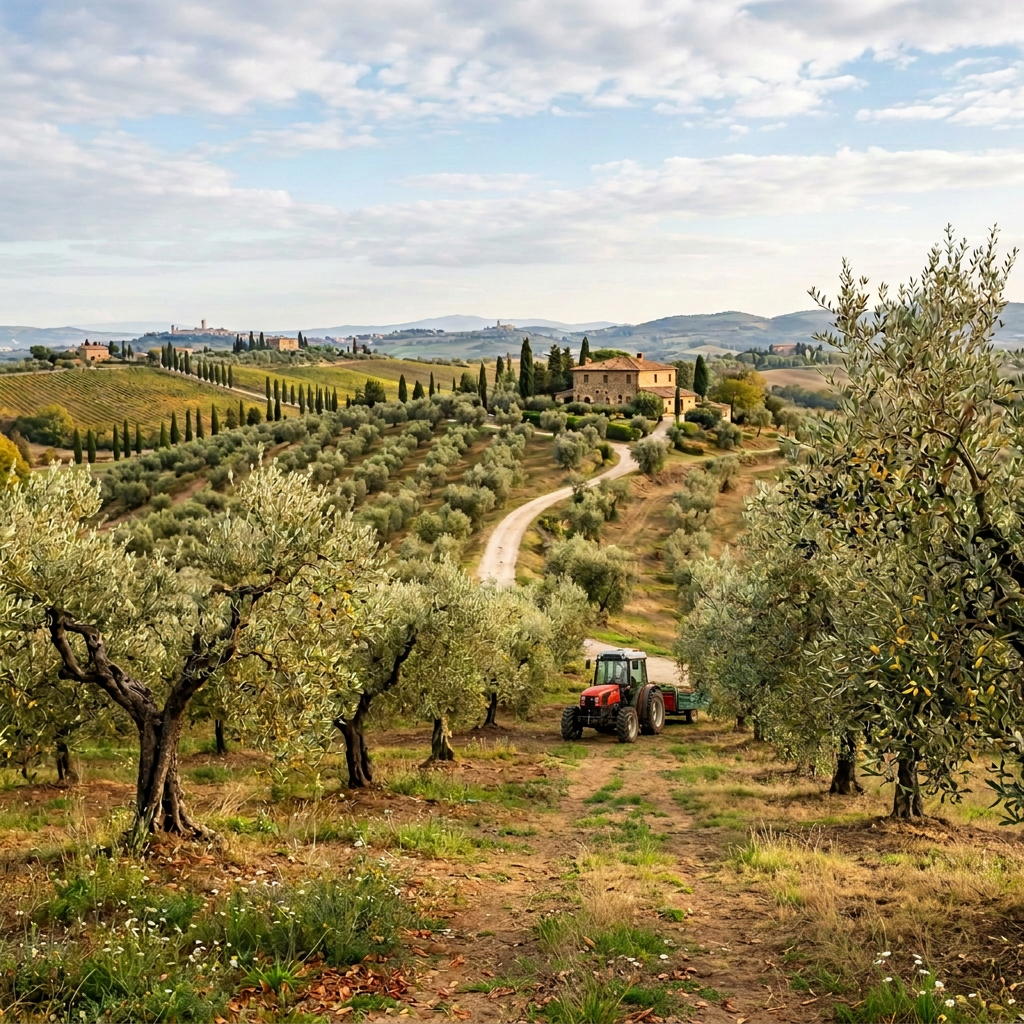
If you’ve ever visited Tuscany in the fall, you may have noticed something happening beyond the vineyards.
The olive groves are busy.
You’ll see nets spread beneath the trees, crates being filled, farmers working among the branches and – if you’re lucky – the unmistakable smell of freshly pressed olive oil.
It’s olive harvest season.
And if you’ve never experienced it, you’re missing one of the most delicious traditions in Italy.
Olive oil isn’t just something Italians drizzle over a salad. In Italy, it is agriculture, history, family tradition, regional identity and an essential part of the table.
And during harvest season, something particularly exciting happens:
Olio nuovo arrives.
Fresh, young olive oil made from the new harvest.
It’s bright. Peppery. Grassy. Fruity. Sometimes almost spicy enough to make you cough.
And it’s absolutely delicious.
So let’s talk about how Italian olive oil goes from tree to frantoio to bottle to your table, where to buy it when you’re traveling in Italy, how to find authentic Italian EVOO once you’re back home, and how to get the most out of that beautiful bottle you brought home.
When Is Olive Harvest Season in Italy?
Olive harvest timing varies depending on the region, olive variety, weather and desired ripeness.
In Tuscany, harvesting generally begins around October and continues through November, with some areas continuing into early December. The traditional Tuscan harvest is often concentrated around late October and November.
In other parts of Italy, the timing can begin earlier or extend later.
That means if you’re traveling around Italy in the fall, you may encounter olive harvesting in Tuscany, Umbria, Lazio, Puglia, Sicily, Calabria, Campania and Liguria.
And each region has its own varieties, traditions and flavor profiles.
This is one of the reasons I think olive oil deserves to be treated a little like wine.
Where the olives grow matters.
What Actually Happens During an Olive Harvest?
Let’s start at the beginning.
The olives grow throughout the spring and summer, gradually developing and changing color as they mature.
Farmers then decide when to harvest based on the variety, ripeness, weather and the style of oil they’re trying to produce.
And here’s something important:
Greener olives don’t necessarily mean better olives, and darker olives don’t necessarily mean better olives.
Harvesting earlier can produce oils that are more intensely green, bitter and peppery, while later harvesting generally produces a riper, softer and fruitier profile.
There isn’t one universally “correct” flavor.
It’s about what the producer is trying to create.
How Are Olives Harvested?
In Tuscany, olive harvesting is traditionally done largely by hand.
Workers may use small rakes or comb-like tools to remove olives from the branches while nets are placed underneath the trees to catch them.
Larger producers may also use mechanical or electric harvesting equipment.
The goal is to remove the olives while minimizing damage to both the fruit and the tree.
That matters because damaged or bruised olives can deteriorate quickly.
Once the olives are picked, time becomes extremely important.
From the Tree to the Frantoio
The olives shouldn’t sit around for days waiting to be processed.
In quality-focused production, they’re transported to the frantoio, or olive mill, as quickly as possible.
At the mill, the olives are:
- Inspected and sorted
- Cleaned and washed
- Separated from leaves and debris
- Crushed into a paste
- Mixed, or “malaxed,” to allow oil droplets to join
- Centrifuged to separate the oil from water and solids
- Filtered or left unfiltered, depending on the producer
- Stored and eventually bottled
The entire process is mechanical rather than involving chemical refining when producing extra virgin olive oil.
And this is why the phrase “extra virgin” matters.
What Does Extra Virgin Olive Oil Actually Mean?
Extra virgin olive oil, or EVOO, is the highest category of virgin olive oil.
According to the International Olive Council, extra virgin olive oil must meet specific chemical and sensory criteria, including a free acidity of no more than 0.8 grams per 100 grams. It must also have the appropriate sensory characteristics for the category.
In other words, “extra virgin” isn’t simply a fancy marketing phrase.
It is a defined category.
And quality isn’t determined by acidity alone.
Professional sensory evaluation looks at positive characteristics such as fruitiness, herbaceous notes, pungency and bitterness.
It also looks for defects such as rancidity, mustiness or fustiness.
Why Is Fresh Olive Oil So Peppery?
This is one of my favorite things to explain to people.
You taste a really fresh, high-quality EVOO and suddenly…
Hello, throat.
That peppery sensation isn’t necessarily a flaw.
Pungency and bitterness are characteristic sensory qualities of virgin olive oil and are associated with phenolic compounds.
A young, early-harvest oil can have an especially pronounced peppery, grassy or bitter character.
And that’s part of the fun.
You can actually taste the harvest.
What Is “Olio Nuovo”?
If you’re in Italy during olive harvest season, keep your eyes open for:
OLIO NUOVO
or
OLIO NOVO
depending on the region and local terminology.
This refers to the fresh new-season oil.
It’s young, vibrant and often intensely aromatic.
In Tuscany, you’ll frequently see it paired with something extremely simple:
Pane e olio.
Bread and olive oil.
That’s it.
No complicated recipe.
Because when the oil is freshly pressed, you don’t need to hide it under ten other ingredients.
How to Taste Fresh Olive Oil
You don’t need a fancy tasting room.
Try this at home with your next bottle.
1. Pour a small amount into a glass.
Professional tastings often use small blue glasses so tasters aren’t influenced by the color of the oil.
2. Warm the glass slightly with your hand.
3. Swirl it.
4. Smell it.
Do you get fresh grass? Green tomato? Artichoke? Apple? Herbs?
5. Take a small sip.
Let it move around your mouth.
6. Notice the finish.
Is it mild? Bitter? Peppery? Fruity? Herbaceous?
And then take a breath in through your mouth.
That can make the peppery sensation much easier to notice.
Where Should You Buy Olive Oil in Italy?
Here’s my biggest piece of advice:
Don’t feel like you have to buy olive oil from the first souvenir shop you see.
There are much better options.
1. Buy Directly From a Frantoio
One of my favorite ways to buy olive oil is directly from the producer or olive mill.
You’ll often be able to:
- Taste the oil
- Ask when it was harvested
- Learn what olive varieties were used
- Find out where the olives were grown
- Compare different oils
- Sometimes tour the mill
This is where you’ll really start to understand olive oil as a regional product.
Visit an Olive Farm
If you’re traveling during harvest season, look for an olive harvest experience.
Tuscany has experiences where visitors can participate in harvesting, visit a mill and taste freshly pressed oil.
There are also olive-mill visits near Florence, including seasonal experiences at farms in the Fiesole area.
This is one of those travel experiences I would choose over simply buying a bottle.
You get the story along with the oil.
Buy From a Good Italian Food Shop
If you don’t have time to visit a farm or frantoio, look for a reputable:
alimentari
bottega
enoteca
specialty food shop
Ask the person working there:
“Qual è l’olio nuovo?”
What’s the new oil?
Or:
“Quale olio extravergine italiano mi consiglia?”
Which Italian extra virgin olive oil do you recommend?
And if you’re in Tuscany:
“Avete olio Toscano IGP?”
Do you have Tuscan PGI olive oil?
Look for DOP & IGP
You’ll often see DOP and IGP on Italian food products.
These are European geographical-quality designations.
For Tuscan olive oil, look for Toscano IGP.
Tuscany also has several DOP olive oil designations, including Chianti Classico, Terre di Siena, Lucca and Seggiano.
That doesn’t mean an oil without a DOP or IGP designation is bad.
It simply gives you another layer of information about origin and production.
What About Buying Olive Oil at an Italian Supermarket?
Yes.
You absolutely can buy good olive oil at an Italian supermarket.
But don’t just grab the prettiest bottle.
Turn it around.
Look at:
Where are the olives from?
Where was the oil produced?
Is it extra virgin?
Is there a harvest date?
How is it packaged?
How has it been stored?
And if you’re looking for a particularly fresh bottle, harvest date is more useful than simply looking at the best-before date.
How to Choose an Italian Olive Oil
When you’re standing in front of a wall of beautiful bottles, here’s what I’d look for.
Extra virgin
If you’re buying oil for finishing, dipping or really tasting the oil, start with EVOO.
Clear origin
Look for language such as:
100% Italian olives
or a specific region, DOP or IGP designation.
Harvest date
A harvest date gives you useful information about freshness.
Dark glass or tin
Light is one of olive oil’s biggest enemies.
Small enough to use
Don’t buy a gigantic bottle just because it’s cheaper per liter if you’re only going to use it occasionally.
Don’t Judge Olive Oil by Its Color
This is a big one.
Green does not automatically mean better.
Color can vary based on olive variety, ripeness and production.
That’s why professional olive oil tasting glasses are often blue: the goal is to prevent color from influencing the taster.
So don’t choose your oil because it looks the most intensely green in the bottle.
Taste it instead.
Where Can You Buy Italian Olive Oil in the United States?
If you’ve returned home from Italy and immediately started missing that bottle of oil you had with your bread every night, I understand.
Fortunately, you don’t have to wait until your next flight to Italy.
Eataly USA
Eataly carries a wide selection of Italian extra virgin olive oils from producers throughout Italy, including oils from Tuscany, Puglia, Sicily, Umbria and other regions.
It’s a good starting point if you want to compare oils by region and producer.
Specialty Olive Oil Retailers
Specialty olive-oil retailers can also be a great option because they often provide harvest dates, producer information and tasting notes.
Buy Directly From the Producer
This is my favorite option when available.
If you discover an olive farm or producer you love while traveling, check whether they ship internationally.
Some small producers now ship new-harvest oil directly to U.S. customers.
For example, Safadi Farm in Tuscany has offered its single-grove Tuscan EVOO to U.S. and Canadian customers in small harvest batches.
Where Can You Buy Italian Olive Oil in Canada?
Canadian olive-oil lovers have some excellent options too.
Eataly Canada
Eataly’s Canadian shop carries Italian pantry products, including Italian extra virgin olive oil, with shipping options within Canada.
Favuzzi
Favuzzi specializes in Italian food products and offers olive oils online in Canada.
Specialty Olive Oil Retailers
Another option is a specialty retailer that sources single-estate and regional Italian oils.
When shopping online, look for retailers that tell you:
- Harvest date
- Country and region of origin
- Producer
- Olive varieties
- Bottling information
- Storage recommendations
The more transparent the retailer is, the better.
What Should You Look for When Buying Olive Oil Online?
Online shopping makes it particularly easy to get distracted by beautiful labels.
Instead, look for information.
A good online listing should tell you as much as possible about:
Harvest date
Country of origin
Region
Producer
Olive varieties
Bottle size
Packaging
Shipping and storage
If you can’t figure out where the olives came from, I’d keep looking.
How Should You Store Olive Oil?
This is where even people who buy expensive EVOO sometimes get it wrong.
Olive oil is sensitive to:
Light. Heat. Oxygen.
So…
Don’t store it next to your stove.
Yes, it’s convenient.
No, it’s not ideal.
Don’t leave it sitting on a sunny windowsill.
Your beautiful bottle might look gorgeous there.
Your oil disagrees.
Don’t leave the cap open.
Oxygen isn’t your friend.
Store it somewhere cool and dark.
A cupboard or pantry is perfect.
Keep the bottle tightly closed.
Every time you pour, close it again.
Should You Refrigerate Olive Oil?
Generally, no.
Refrigeration isn’t necessary for most household olive oil and can cause the oil to become cloudy or solidify.
The better strategy is simply to keep it away from heat and light.
A cool, dark pantry is ideal.
Should You Buy Olive Oil in Large Bottles?
Only if you use it quickly.
This is one of my biggest olive-oil lessons:
Freshness matters more than buying in bulk.
Once a bottle is opened, oxygen begins interacting with the oil.
If you’re someone who uses olive oil every day, a larger bottle may make sense.
If you only drizzle it over salads occasionally, buy a smaller bottle.
I’d rather have you finish a smaller bottle while it’s still vibrant than keep a giant bottle sitting in your pantry for two years.
Can You Cook With Extra Virgin Olive Oil?
Yes.
This is a myth that needs to retire.
Extra virgin olive oil can absolutely be used for cooking.
It’s excellent for:
- Sautéing
- Roasting vegetables
- Baking
- Making sauces
- Grilling
- Pan-frying
- Finishing soups and stews
And of course, it is fantastic raw.
The key is choosing the right oil for what you’re making.
Save Your Best Olive Oil for Finishing
If you’ve splurged on a beautiful single-estate EVOO, don’t necessarily use it to fry onions for an hour.
Use it where you’ll actually taste it.
Try drizzling it over:
- Ribollita
- Pappa al pomodoro
- Grilled bread
- Fresh tomatoes
- Burrata
- Mozzarella
- Roasted vegetables
- Grilled fish
- Beans
- Pasta
- Soup
- Eggs
Or simply…
Good bread + excellent olive oil + a little salt.
That’s one of the easiest ways to appreciate a really good bottle.
Olive Oil + Balsamic: A Classic Combination
One of my favorite Italian food souvenirs is a beautiful bottle of olive oil paired with a good balsamic vinegar.
Try them with:
Parmigiano-Reggiano
Fresh bread
Strawberries
Roasted vegetables
Caprese salad
Or even vanilla gelato if you’re feeling adventurous.
Just remember that traditional balsamic vinegar from Modena is its own specialty product with its own production rules and aging traditions.
Don’t assume that every bottle labeled “balsamic” is the same.
How Long Does Olive Oil Last?
Olive oil doesn’t improve with age the way some wines do.
Quite the opposite.
It gradually loses its freshness and aromatic qualities.
That’s why I prefer to think of olive oil as something to use and enjoy, not something to save indefinitely for a special occasion.
If you’ve brought home a beautiful bottle from Italy, open it.
Use it.
Enjoy it.
And then buy another one.
How Can You Tell If Olive Oil Has Gone Bad?
Your nose knows.
If your oil smells stale, waxy, musty, like old crayons or otherwise unpleasant, it may have gone rancid.
A fresh EVOO should smell and taste fresh rather than flat and stale.
And if the oil no longer tastes good?
Don’t force yourself to use it just because it was expensive.
Quality olive oil is meant to be enjoyed.
My Favorite Way to Enjoy Italian Olive Oil
Honestly?
I don’t think it needs to be complicated.
Get a loaf of good Italian bread.
Pour some fresh EVOO into a little dish.
Add a pinch of salt.
Dip.
That’s it.
If the oil is fresh and flavorful, you’ll taste the fruitiness, bitterness and peppery finish.
And suddenly you’re back in Tuscany.
Standing in an olive grove.
The harvest happening around you.
The smell of freshly pressed oil in the air.
And a very simple reminder that some of the best things in Italy don’t need much at all.
If You’re Visiting Italy During Olive Harvest…
Don’t just take a picture of the olive trees.
Taste the harvest.
Look for an olive farm or frantoio offering tours or tastings.
Ask when the olives were harvested.
Ask which varieties they grow.
Try the new oil.
Learn how it’s made.
And if you find a producer you love, bring a bottle home.
Or ask if they ship.
Because one of the best souvenirs from Italy isn’t something that sits on a shelf.
It’s something you can open at your kitchen table and immediately remember where you were.
My Italian Olive Oil Shopping Checklist
Before buying a bottle, ask:
Is it extra virgin?
Where were the olives grown?
When were they harvested?
Who produced the oil?
Is there a DOP or IGP designation?
Is it packaged in dark glass or a tin?
Has it been stored away from heat and light?
Can I taste it?
Can the producer tell me about the harvest?
If you can answer most of those questions, you’re on the right track.
Bring a Little Italy Home With You
One of my favorite things about traveling in Italy is discovering that the best souvenirs aren’t always the ones you’ll find in a gift shop.
Sometimes they’re edible.
A bottle of wine.
A wedge of cheese.
A bag of pasta.
And a bottle of really good olive oil.
So if you’re traveling through Tuscany, Puglia, Umbria or another Italian olive-growing region during harvest season, make time for the olive groves.
Talk to the producers.
Taste the new oil.
And don’t be afraid to ask questions.
Because once you’ve experienced olio nuovo at its freshest, you’ll never look at that bottle of olive oil in your kitchen quite the same way again.
Buon appetito….and buon raccolto!
XO,
Sondra
Leave a Reply